


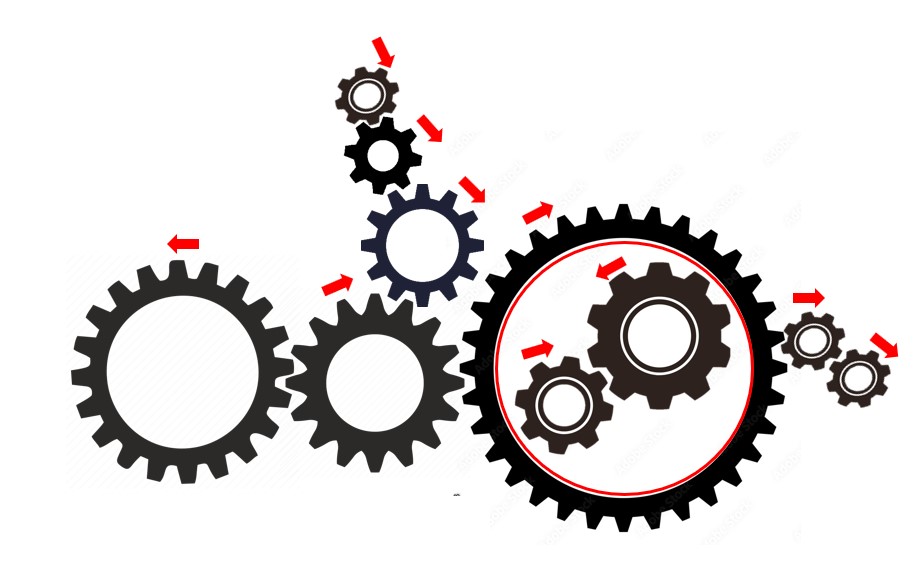
This is a great diagram. A go to classic for those “do you get what I am saying?” situations – you can even draw it quickly on a whiteboard.
Setting the scene…
For over a decade I worked at two SaaS startups that both grew quickly and more recently on a very large and complex implementation program with a large team (150+) and impacted business users in the tens of thousands.
At both the startups they were in their growing phase. One of my CEOs would say we were “teenage” the other “more like troubled teenagers”. Its the phase where you are starting to wing it a bit less. You have won some good customers and you are starting to think about more than just closing the next deal. Things like actually properly looking after your existing customers – retention/renewal. You have some money in the bank and good cashflow. For Product Development Teams and Support Teams you are trying to put in the ‘scaffolding’ that allows for scalable and sustainable growth.
At the top of the organization and at Board level its the phase where medium-term planning becomes ‘a thing’ – lets explore potential new revenue channels, lets explore acquisitions, lets explore new product directions…
Then more recently in the big implementation program we are dealing with:
- managing the business change impacts of the solution, and also
- managing the project changes that impact the solution
yep read that back again it does make sense – the business is validly worried about process and operational change impacts and the project team are validly worried about the solution impacts if we descope something to hit a key date.
At the top of the organization for both the project governance leadership and the business operations leadership its time for some change…
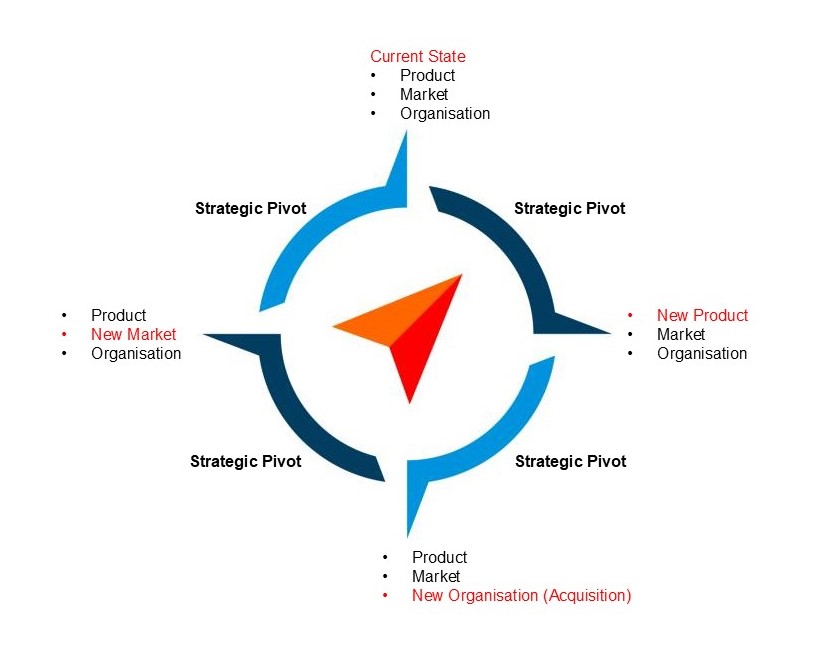
Lets make a strategic pivot…
If you make four small strategic pivots (and mathematically each pivot is no more than say 45 degrees in ‘business impact’ degrees – so not too radical) be careful on direction as you could end up being back where you started.
But most strategic pivots are not always in the same direction – the direction alternates – think of it more like being in a yacht and tacking along the length of the course – you want to reach the next course marker as quickly as you can, but you can take advantage tacking to the best winds to get you there. I have sailing buddies who say business is just like sailing – I say its more like business can make you enough money to go sailing… or maybe not.
Strategic Pivots and the Cogs diagram…
So what happens if you make a strategic pivot? – well you change direction.
Sets of interconnecting cogs provide a great representation for the organizational dynamic of change. THEY GIVE A GREAT VISUAL OF IMPACT
At the top level of an organization strategic business planning or a business opportunity might lead to a strategic pivot – it could be a smallish one less than 45 degrees in its ‘business impact’ degrees – or even a tiny one say only 2-3 notches in the cog or even just one notch at a time (BTW one notch at a time is like ‘continuous improvement’ – its no game-changer)
All the cogs are mechanically interconnected so the direction the first cog is moving in directly influences the direction of any cogs it is connected with.
In the diagram the top cog is intentionally small – it is the Executive layer of the organization – or the Board.
As you move downwards into the operational part of the organization the cogs get bigger – bigger teams (e.g. product development) – bigger interconnected cogs (e.g. product teams connecting with support teams), cross-team alignment (e.g. sales teams connecting with implementation teams), regional cogs (e.g. onshore capability connecting with offshore capability) etc etc
These cogs are all people moving in the same business direction – as it should be.
Now look at the cascading impact of the (small) strategic pivot as its impact makes its way way from the top to the bottom of the organization. If you use real examples you get some great talking points
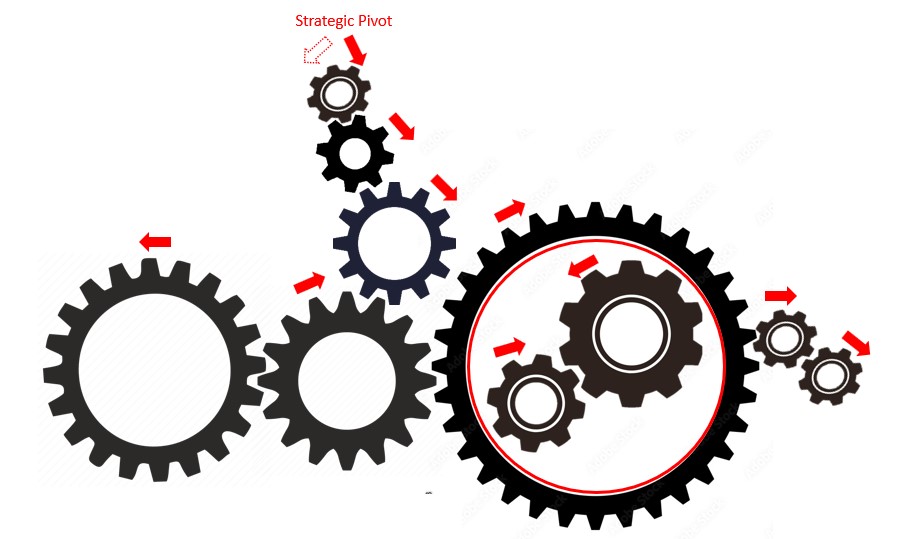
IMPACT – every single interconnected cog has to change direction
TIME – this also takes time – the bigger the cog the longer
INDIRECT IMPACT – Some cogs are indirectly impacted – they’re not even part of the main game (support teams is a classic example)
OBLIVIOUS TO CHANGE – Some cogs are actually not connected at all – they won’t even be aware of the change and just keep doing what they do – that might be good or bad?
Using the cog diagram examples:
“Please understand the impacts across our organisation of this strategic direction change”
“Please understand the impact is bigger in some areas than others”
“Please understand what happens if we remove (e.g. descope) a key cog”
“Please understand if we change a mid-level cog it has upstream and downstream change impact”
“Who will manage the impacts as each cog changes direction”
“Look how many areas may need training, support to make the change”
etc etc
ok I’ll stop – the fun is working out how to use the message
FINAL WORDS: BUSINESS IMPACT ASSESSMENT
In the Enterprise Architecture space, we seek to identify the ‘cogs’ in a business as either ‘groups of cogs’ or ‘individual cogs’ that together represent business (or technical) ‘capabilities’. The capabilities are the critical ‘what’ and the cogs the less important and always changing ‘how’.
That understanding allows us to be able to proactively do business impact assessment to determine ‘what’ capabilities are impacted and by how much – and we can do this BEFORE the change is made – or if you are betting the business on success then BEFORE the strategic pivot itself.
WANT MORE
I don’t want to spoil a good analogy or maybe just push it too far but if you got the basics of how the cog diagram can illustrate change then at this point you can explore ‘idler gears’.
They control three ‘magical elements’ of cogs (or teams or processes or whatever…)
- 1. Keeping cogs turning in the same direction reducing impact
- 2. Managing the speed of change across cogs
- 3. Managing the extent of impact between cogs
If you are dealing with business change and strategic pivots think about where you might want to have ‘idler gears’ – conceptually they are a de-risking tool. Check out the video.
 My Working Life
Leave a comment