


Urgency and Importance
This week I was thinking about how I set work priorities, as I know I do this very carefully. I was contrasting this to how I set priorities for the ‘home, life and wellbeing‘ stuff where I apply far less rigor possibly just ‘winging it’- not good and more the method of the Doris Day song: “Que sera, sera Whatever will be, will be”. So I am guessing my priority setting approaches might compete or conflict with each other. I worked out I was putting more effort into prioritizing trivial things than for the things that matter most. I have decided to see if I could improve the situation.
The decisions we make about our priorities are possibly the most important decisions we make in our lives. I make this point in the most holistic of contexts. So not so much whether I do Task A before Task B or what needs to be finished before I leave the office, more about ensuring my own wellbeing, supporting the family, and achieving life goals.

The process I have been using for a few years now for priority setting (mainly at work) is a method I created myself I call ‘The Three Ds’. Its simple but also elegant and involves a sequential grouping of priorities using the three D categories. I have a nice article about it here.
The Eisenhower Principle
More recently at work I have been finding the use of the ‘Eisenhower Principle’ has been very helpful as an ‘overlay’ to ‘The Three Ds’. Its not knew and has been around since 1954…
EISENHOWER PRINCIPLE
“I have two kinds of problems: the urgent and the important. The urgent are not important, and the important are never urgent.”
Dwight D. Eisenhower
At its heart applying the principle seeks to clarify the difference in priority for the important and the urgent.
Urgent items are always focused on the present and seek immediate attention and if they are not dealt with, the consequences also happen right now.
Important items on the other hand belong to long-term goals and items of strategic or holistic value. They are “slower” and part of a longer set of goals and priorities connected to personal or professional or organizational development or outside of the office can be important personal goals.
It is quite similar to ‘The Three Ds’ and you can use them together.
Setting Priorities
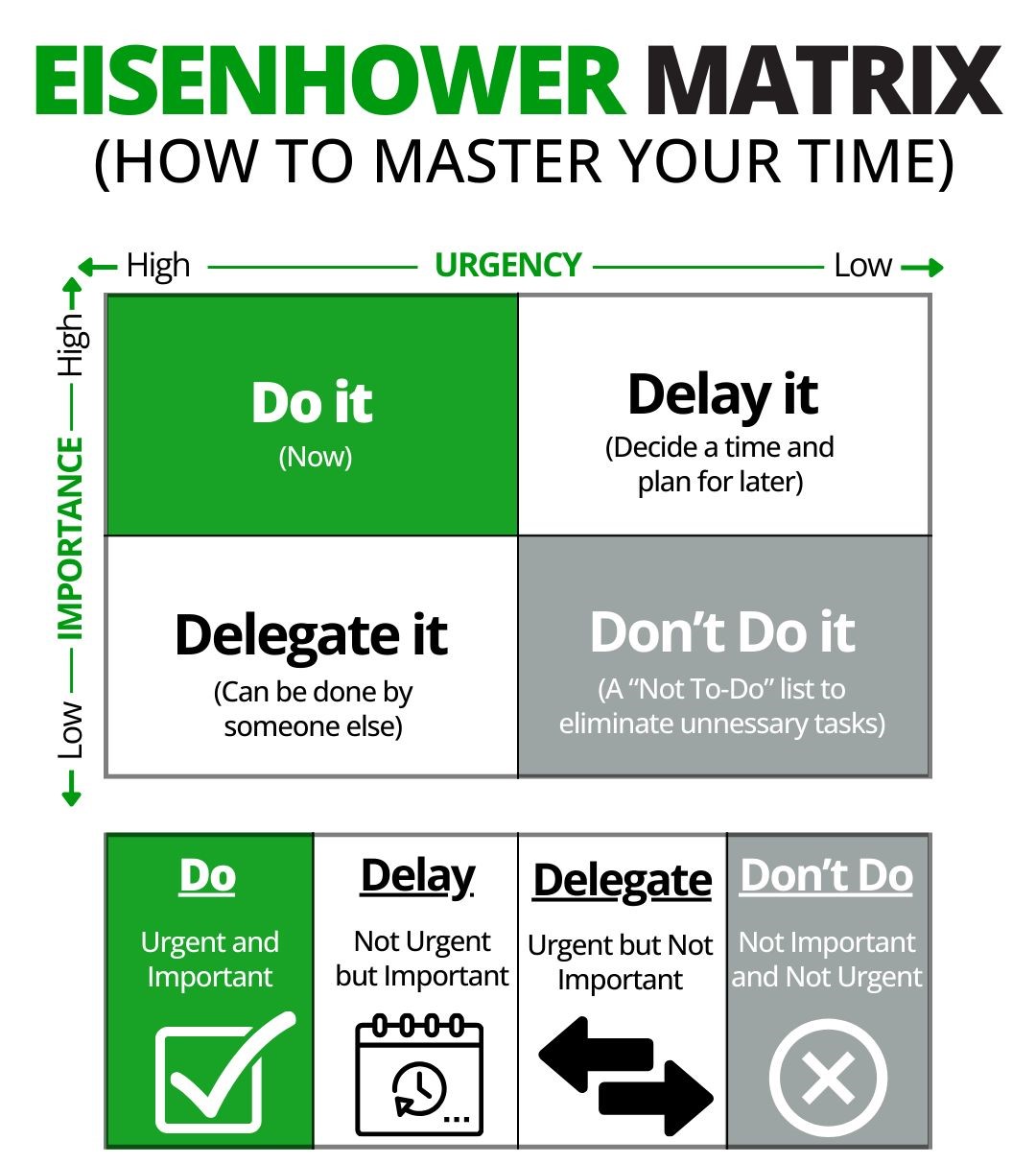
There are a million graphics for an Eisenhower Matrix. I like this one.
The ‘Eisenhower Matrix’ has four categories (or quadrants) with an extra very valuable time-based priority filter that considers ‘urgency’ and ‘importance’ (Do It and Delay it)
‘The Three Ds’ works on the rule of thirds and sequentially grouping starting with ‘Don’t Do It’ (as per Eisenhower) = Deflect (as per ‘The Three Ds’.
Combining them after you have determined what you will not do then you are left with what you will do or delegate (the remaining two thirds) and once you have delegated (the delegate really owns the priority) you now apply urgency to the priorities you must DRIVE as you own them.
Holistic Priority Setting (outside the office)
The approach I am experimenting with is to run two sets of priority tracker lists based on the matrix. One for work and one for home applying the same base criteria in both.
The criteria follow and are followed by some Tips.
PRIORITY 1. Urgent & Important (Things to Do First):
These are the tasks that need your immediate attention.
They are crucial and can’t wait.
In the Three Ds these are DRIVE tasks to do now.
PRIORITY 2. Not Urgent & Important (Things to Schedule for later):
These tasks are important but not urgent.
They can be planned for later.
In the Three Ds these are DRIVE tasks that can be done later.
Examples include studying for a test next week or working on a long-term project.
PRIORITY 3. Urgent & Not Important (Things to Delegate to others):
These tasks seem urgent but don’t really contribute much to your goals.
It’s okay to ask for help or delegate them to someone else.
In the Three Ds these are DELEGATE tasks. The person delegated really now wns the priority but you may want to keep a close eye on them – this applies equally whether assigned to a team member in the office or your partner at home.
PRIORITY 4. Not Urgent & Not Important (Things to Eliminate):
These tasks are neither urgent nor important.
They are time-wasters and distractions.
It’s best to let go of them completely.
In the Three Ds these are DEFLECT tasks. These are identified first as they may be incorrectly assigned to you, and this may need to be addressed. This is a key step to DE_CLUTTER as priorities are being removed


Some Tips
Someone like Don Draper in Mad Men – now he knew how to set his priorities. He certainly had as a priority looking after his own brand. Throughout seven seasons of the show we saw him trying to balance work and home and life goals priority setting. Often he was wrong – and very often he was wrong on the home front. But in the end as per the final episode he learnt just like in the Coke ad that “Happiness is the real thing”
TIP For your home and life priority setting set some categories as its just too complicated to simply sequence a list.
TIP THe diagram above with Don Draper meditating on his priorities has a pretty good starting list of holistic categories.
Categories to the left are more self-orientated (or ‘inwards looking) while categories to the right are more ‘externally’ focused. Self-orientated tasks you kind of have more control over where externally focused categories may involve others and cannot so easily be self-managed.
At the top is the ‘Now?’ – its a filter for urgency
At the bottom is Future? – its a filter for urgency
The categories are a template only bit they looked pretty good for me.
So in summary I’m applying a priority filter across the categories that allows management over time. For example,a period of quiet social activity such as not going t the pub too much can enable a corresponding period of intellectual and creative activity such as leaning something new and a holistic life priority achievement.
I will provide an update.


 My Working Life
Leave a comment