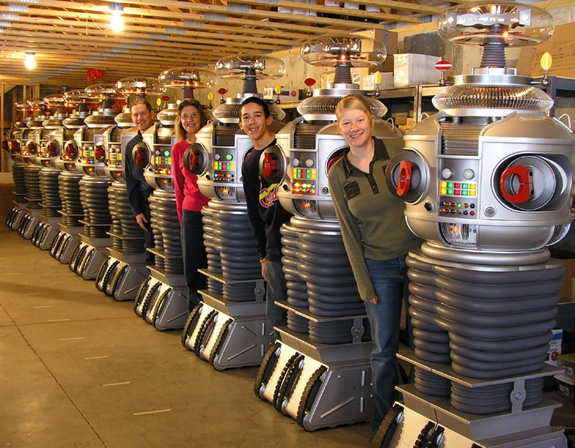


Here are two theory areas I like. I think more people working in IT and especially in both enterprise and solution architecture need to get across ‘Moravec’s Paradox’ and ‘Nouvelle AI’ and how they work together.

‘Moravec’s Paradox’ …suggests that, contrary to traditional assumptions, high-level reasoning requires very little computation, but low-level sensorimotor skills require enormous computational resources. For IT planners working with business and customers this means in practice that the mental abilities of a four-year-old that we take for granted such as recognizing a face, lifting a pencil, walking across a room, or answering a question, are all much harder to automate, than say achieving adult level and expert-level performance on rules-based and reasoned-based processing such that an Adviser, or a Clinician might exhibit.
‘Nouvelle AI’…challenges classical AI by aiming to produce, instead of supercomputers, simple robots with intelligence levels similar to insects. Overall intelligence can emerge organically from simple repeated behaviors as these insect intelligences interact – remember the ants and bees.
By ‘peeling away the onion’ of task complexity and decomposing seemingly very complex tasks into their component ‘insect’ units, and then using an IT ecosystem to bring them together into new solutions – leveraging both the IT expertise of the ‘share’ economy and leveraging the computing power of the cloud to do this – the resulting solutions solve what at first appears to be very complex process challenges such as ‘advice-automation’, ‘risk management’ ‘HR candidate selection’ or ‘clinical diagnostics’.
Nouvelle artificial intelligence, an approach to artificial intelligence (AI) pioneered at the Massachusetts Institute of Technology (MIT) AI Laboratory by the Australian scientist Rodney Brooks (see also below) during the latter half of the 1980s.
Nouvelle AI distances itself from strong AI, with its emphasis on human-level performance, in favour of the relatively modest aim of insect-level performance.
A central idea of nouvelle AI is that intelligence, as expressed by complex behaviour, “emerges” from the interaction of a few simple behaviors.
An Enerprise Architecture perspective:
To draw a long very thin thread on this. To me this is where ‘understanding’ the business problem meets ‘leveraging’ the technology solutions. This is a higher architectural pursuit than time spent theoretically modelling an organization’s ‘information’, ‘business’, ‘application’ and’ technology’ domains given a very high value in EA. As an alternative case study these two AI pursuits are “architecture with intent…”.
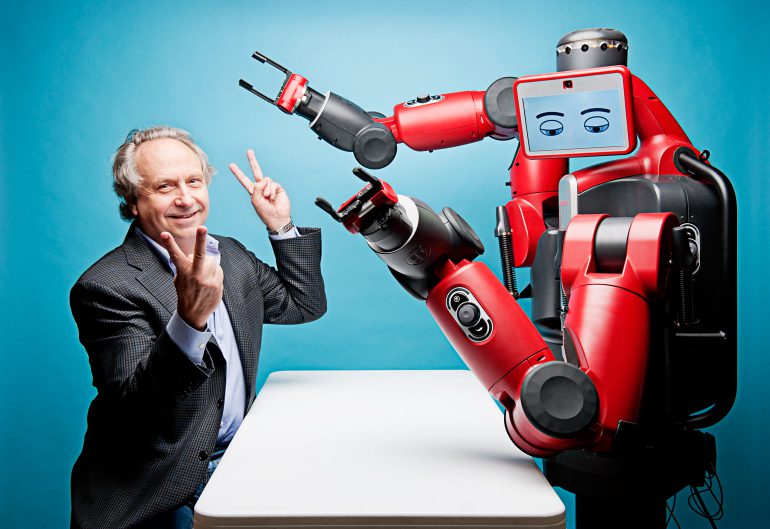
About Rodney Brooks
Rodney Brooks (born December 30, 1954) is an Adelaide, Australian born computer scientist, artificial intelligence scientist, and designer of mobile autonomous robots. He was the founder and CTO of Rethink Robotics, who was also the director of MIT’s Computer Science & Artificial Intelligence Laboratory (CSAIL) and one of the founders of iRobot makers of the Roomba, a small autonomous vacuum cleaner robot that can clean a floor with no supervision or you have probably followed the evolution of the Mars Rovers, the robotic vehicles that help to map the Mars surface and conduct a series of experiments. What is the connection between the two projects?

iRobot, the company that manufactures the Roomba was co-founded by Rodney Brooks, who is also associated with the Rover series of robots that are conducting experiments on Mars for years now.

While attending Flinders University in Adelaide, South Australia, where he received bachelor’s (1975) and master’s degrees (1978) in pure mathematics, Brooks was given access to the university’s mainframe computer for 12 hours each Sunday. This experience with computers was enough to convince Brooks to come to America to study with the artificial intelligence (AI) pioneer John McCarthy at Stanford University in California. Brooks chose a traditional AI problem for his doctoral research (1981), which he subsequently expanded and published as Model-Based Computer Vision (1984).
More on Rodney Brooks in ‘Fast, cheap and out of control’: How Rodney Brooks transformed AI by Peter Manthos here (but you have to subscribe to Medium)

 My Working Life
Leave a comment